
TL;DR
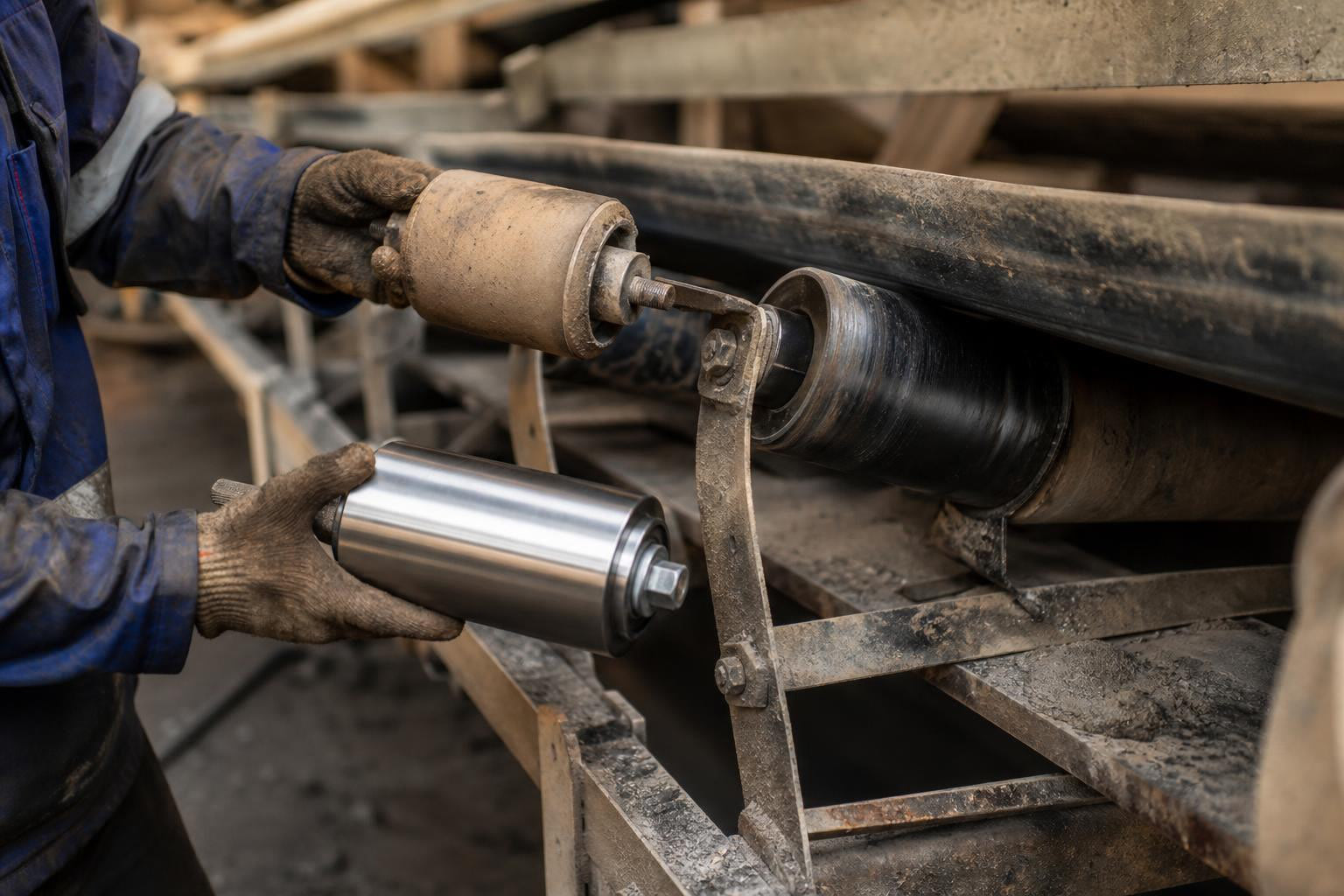
Plastic guide rollers made from UHMW, nylon, or polyurethane wear out fast in mining, aggregate, and cement operations due to abrasion, heat, and dust contamination. Replacing worn plastic guide rollers with steel alternatives dramatically extends service life, reduces maintenance frequency, and lowers total cost of ownership. This glossary defines every term you will encounter when evaluating the upgrade from plastic to steel side guide rollers, and provides a practical framework for making the switch.
Introduction: Why This Glossary Exists
If you are reading this, you have probably already replaced your plastic guide rollers more times than you care to count. The cycle is familiar: install new UHMW or polyurethane rollers, watch them grind down in weeks or months, pull the belt offline, and do it all over again. In mining, aggregate, and cement plants, this is not just an annoyance. It is a safety issue.
According to MSHA data, mistracking accounts for approximately 30% of conveyor belt fires, primarily due to friction from critical misalignment. Guide rollers exist to prevent that misalignment. When they fail prematurely because the material cannot handle the environment, the consequences cascade: belt edge damage, spillage, fire risk, and unplanned downtime.
This glossary covers every term you will encounter when you decide to replace worn plastic guide rollers with steel alternatives. Each definition connects directly to the upgrade decision, so you can speak the language, evaluate products, and justify the switch to your team or procurement department. If you are already seeing signs of a misaligned conveyor belt, this page will help you understand exactly why steel guide rollers solve the root problem.
The Problem: Why Plastic Guide Rollers Fail in Harsh Duty
Before diving into the glossary, it helps to understand why plastic guide rollers keep failing. The answer is straightforward: the materials are not built for the punishment that mining, quarry, and cement environments deliver.
The three most common plastic materials used in guide rollers are UHMW-PE (ultra-high molecular weight polyethylene), nylon, and polyurethane. All three share fundamental weaknesses when exposed to heavy abrasive loads, temperature swings, and fine particulate dust.
Abrasion wear-through is the most visible failure mode. Plastic is simply not as strong or durable as steel as a base material. In applications where sharp aggregate, trap rock, or cement clinker contacts the roller surface, plastic wears through in a fraction of the time steel would last.
Thermal warping is the second killer. Plastic has a much greater coefficient of thermal expansion than steel. In hot environments (near drive pulleys, in direct sun, or in cement kilns), plastic rollers deform and lose their round profile. Once warped, they cannot maintain proper belt contact.
Bearing contamination follows shortly after. Plastic housings degrade faster under fine dust ingress, and bearing contamination is one of the leading causes of idler failure across the industry. When the housing cracks or softens, dust and moisture reach the bearing, and seizure is not far behind.
Load-limit exceedance rounds out the list. The potential cost savings of plastic rollers are quickly offset by their limited load-bearing capacity. A heavy belt loaded with wet aggregate can simply crush a plastic guide roller that a steel one would shrug off.
Practitioners on the Practical Machinist forum echo this experience. One hands-on user warns bluntly: “Plastic bar stock will take a set, steer clear. Use steel or aluminum tubing and press ends into it to hold your bearings.” That advice aligns with what maintenance teams in the field report consistently. To understand the downstream effects when guide rollers fail, read about the consequences of belt misalignment.
Core Glossary: Terms for the Plastic-to-Steel Upgrade
Each entry below is written through the lens of replacing worn plastic guide rollers with steel alternatives. Terms are alphabetical for quick reference.
Abrasion Resistance
The ability of a material to withstand surface wear from contact with abrasive particles. In conveyor applications, abrasion resistance determines how long a guide roller lasts before it needs replacement. Steel inherently outperforms UHMW-PE, nylon, and polyurethane in abrasive environments because its molecular structure is denser and harder. Heat-treated steel pushes this advantage further. When you are running trap rock, limestone, or cement clinker, abrasion resistance is the single most important property separating a roller that lasts months from one that lasts years.
Why it matters for the upgrade: This is the primary reason to replace plastic guide rollers with steel. Higher abrasion resistance means fewer changeouts, less downtime, and lower long-term costs.
Bearing Seizure
A failure condition where a roller’s internal bearing locks up and stops rotating freely. The roller then drags against the belt instead of turning with it, creating friction, heat, and accelerated belt wear. Bearing seizure is almost always caused by contamination, where dust, moisture, or fine abrasive particles infiltrate the bearing housing and destroy the lubrication film. Plastic housings are more vulnerable to this because they crack and degrade faster under environmental stress, creating pathways for contaminants.
Why it matters for the upgrade: Steel guide rollers with proper sealing (contactless seals, mechanical dust covers) dramatically reduce the risk of bearing seizure by keeping contaminants out longer.
Belt Edge Curl
A deformation of the conveyor belt edge where the rubber curls upward or downward, typically caused by the belt riding against a stationary frame member or misaligned structure. Belt edge curl accelerates belt wear, creates spillage points, and can make the belt impossible to track properly. Side guide rollers prevent edge curl by providing a rotating contact surface that redirects the belt without dragging against it.
Why it matters for the upgrade: A steel guide roller that stays round and keeps spinning prevents edge curl. A plastic roller that has warped or seized causes it.
Belt Mistracking
The lateral wandering of a conveyor belt off its intended path. Mistracking is the fundamental problem that guide rollers are designed to solve. Causes include uneven loading, off-center material feed, frame misalignment, and worn components. The consequences range from spillage and edge damage to structural contact and belt fires. MSHA data links mistracking to roughly 30% of conveyor belt fires. Learn more about how side guide rollers work to control belt mistracking.
Why it matters for the upgrade: A guide roller that wears out prematurely leaves the belt unguided. Steel alternatives maintain alignment protection longer, reducing the window of exposure to mistracking events.
Contactless Sealing
A bearing protection method that creates a labyrinth or gap-based barrier between the bearing and the external environment without physical contact between seal surfaces. Because the seal components do not touch, there is no friction-generated heat and no seal wear. This is particularly valuable in dusty environments where traditional contact seals can grind abrasive fines into the bearing rather than keeping them out.
Why it matters for the upgrade: Steel guide rollers with contactless sealing last longer in dusty mining and cement applications because the seal itself does not become a wear point or contamination pathway.
Greasable Bearing
A bearing assembly that includes a grease fitting (zerk) allowing field re-lubrication without disassembly. In heavy-duty service where dust ingress is constant, the ability to flush fresh grease through the bearing extends operating life significantly. Some operations report that periodic re-greasing allows them to keep rollers in service well beyond their expected lifespan.
Why it matters for the upgrade: When replacing plastic guide rollers with steel alternatives, look for options that include greasable bearings. This feature lets maintenance teams extend roller life through routine lubrication rather than full replacement.
Heat Treatment (Case Hardening)
A metallurgical process that increases the surface hardness of steel while maintaining a tougher, more ductile core. Case hardening exposes the steel to carbon-rich environments at high temperatures, creating a hard outer shell that resists abrasive wear. Heat-treated steel rollers are the standard for applications demanding exceptional wear resistance, such as in grinding mills, crushing circuits, and heavy mining conveyors.
Why it matters for the upgrade: Heat treatment is the feature that separates a basic steel guide roller from one built for extreme duty. If your plastic rollers were failing from abrasion, heat-treated steel addresses the root cause directly.
Mechanical Dust Cover
An add-on protective cover that physically shields the bearing area from falling debris, dust, and water. Dust covers are most important when a guide roller is mounted with the spindle pointing upward, because gravity pulls contaminants directly toward the bearing entry point. When the spindle points down, gravity works in the roller’s favor, and a dust cover may not be necessary.
Why it matters for the upgrade: This is a detail that plastic roller users often overlook because plastic housings tend to be simpler (and fail faster regardless). When switching to steel, adding a mechanical dust cover for upward-spindle installations protects your investment.
Mild Carbon Steel
A low-carbon steel alloy (typically 0.05% to 0.25% carbon) that offers good strength, weldability, and machinability at a reasonable cost. Mild carbon steel is the base material for most industrial guide rollers. It provides a significant step up from any plastic in terms of abrasion resistance, load capacity, and dimensional stability. Steel rollers have been the mining industry standard for years and are manufactured at economies of scale, which keeps unit costs competitive.
Why it matters for the upgrade: Mild carbon steel is the starting point for a steel guide roller. For standard duty, it may be sufficient on its own. For extreme abrasion, it serves as the base for heat treatment.
Pizza Wheeling
A condition where a steel roller is used past its operating life and the roller shell wears through, exposing the side plates. The exposed edge of the side plate acts like a pizza cutting wheel, slicing into the conveyor belt as it runs. This is the most commonly cited objection to steel guide rollers.
The fix is a simple design change: increasing the thickness of the roller sidewalls eliminates the sharp edge that causes cutting. With thicker sidewalls, even a heavily worn roller does not present a thin, blade-like profile to the belt.
Why it matters for the upgrade: Pizza wheeling is a real risk, but it is a solved problem. When evaluating steel alternatives, confirm that the roller design uses thicker sidewalls to prevent this failure mode.
Return Side / Rack Side
The locations on a conveyor system where guide rollers are most commonly installed. The return side is the bottom run of the belt, traveling back toward the tail pulley after discharging material. The rack side refers to the structural framework where rollers mount. These areas are particularly prone to mistracking because the belt is empty and more susceptible to wind, vibration, and residual material buildup.
Why it matters for the upgrade: Understanding where guide rollers go helps you order the right quantity and bracket configuration. Most installations use pairs of guide rollers at key locations along the return side.
Reversing Belt
A conveyor belt system that operates in both forward and reverse directions, used in applications like shuttle conveyors, stackers, and bidirectional transfer systems. Reversing belts present a unique alignment challenge because many tracking devices (particularly offset training idlers) are direction-sensitive. Installing a training idler on a reversing belt can actually worsen mistracking when the belt changes direction. Side guide rollers are non-directional, making them the preferred alignment device for reversing belt applications.
Why it matters for the upgrade: If you are running reversing belts, steel side guide rollers are not just an upgrade from plastic. They are the only practical guide roller option, period. For a broader overview, see types of guide rollers for conveyor belts.
Roller Bracket
The mounting hardware that attaches a guide roller to the conveyor frame. A properly designed bracket holds the roller at the correct angle and height relative to the belt edge, and allows for adjustment as needed. Mismatched brackets create installation headaches, incorrect roller positioning, and premature wear.
Why it matters for the upgrade: When you replace worn plastic guide rollers with steel alternatives, make sure the bracket is designed to match. Using a purpose-built guide roller bracket simplifies procurement and ensures correct fit.
Side Guide Roller
The core component in this upgrade. A side guide roller is a small, vertically or angle-mounted roller installed along the edges of a conveyor belt to prevent lateral wandering. These rollers maintain precise belt alignment, prevent slippage, and reduce wear on the belt edge. Best practice from industry publications recommends installing side guide rollers in pairs ahead of the tail pulley to align the belt and eliminate spillage. They can also be installed after the feed area on troughing sets to keep the belt centered.
Side guide rollers are essential for maintaining the alignment and efficiency of any conveyor system. Unlike training idlers, they are non-directional and work on both standard and reversing belt configurations.
Why it matters for the upgrade: This is the part you are replacing. A steel side guide roller built from mild carbon steel with optional heat treatment will outlast UHMW or polyurethane by a significant margin in abrasive service.
Total Cost of Ownership (TCO)
A financial framework that accounts for all costs associated with a product over its entire useful life, not just the purchase price. For guide rollers, TCO includes the unit cost, shipping, installation labor, downtime during changeouts, belt damage caused by failed rollers, and disposal. Steel rollers are generally more durable and have a longer lifespan, resulting in lower long-term maintenance and replacement costs. Plastic rollers are cheaper initially but may require more frequent replacements. In high-volume operations, the ongoing maintenance costs add up fast.
Steel is also recyclable and can be repurposed at end of life, making it a more environmentally responsible option compared to plastic rollers that go to landfill.
Why it matters for the upgrade: TCO is the argument that wins budget approval. A steel roller that costs more per unit but lasts two, three, or five times longer than plastic costs less per operating hour. For a deeper comparison, check out the side guide roller buyer’s guide.
Training Idler
A conveyor idler designed to correct belt mistracking by using an offset or tilted frame that steers the belt back toward center. Training idlers work well in single-direction conveyor systems but have a critical limitation: the design is not symmetrical. On a reversing belt, a training idler will worsen mistracking when the belt changes direction. This makes training idlers unsuitable for bidirectional applications.
Why it matters for the upgrade: Training idlers and side guide rollers serve different purposes. If you are replacing plastic guide rollers, you are not looking for a training idler. You are looking for a direct material upgrade in the same form factor. Understanding this distinction prevents buying the wrong component.
Transverse Forces
Lateral forces acting perpendicular to the belt’s direction of travel. These forces push the belt sideways and are caused by off-center loading, wind, material buildup on rollers, diverter bars, and belt tension imbalances. Side guide rollers absorb transverse forces at the belt edge, redirecting the belt back toward center without creating a hard stop that would damage the belt.
Why it matters for the upgrade: Steel guide rollers handle transverse forces better than plastic because they do not deform under lateral load. A plastic roller under heavy side-loading can compress, deflect, or crack. Steel holds its shape.
UHMW-PE (Ultra-High Molecular Weight Polyethylene)
A thermoplastic polymer known for its low friction coefficient, chemical resistance, and light weight. UHMW-PE is the most common plastic material used in conveyor guide rollers. It performs well in low-load, clean environments like food processing. In mining, aggregate, and cement applications, UHMW-PE breaks down due to abrasion, heat, and mechanical loading that exceed its material limits. It also has a significantly higher coefficient of thermal expansion than steel, meaning it warps and loses dimensional accuracy in hot environments.
Why it matters for the upgrade: This is the material you are moving away from. Understanding its limitations confirms why the switch to steel is necessary for harsh-duty applications.
Steel vs. Plastic Guide Rollers: Quick Comparison
| Property | Steel (Mild Carbon) | Plastic (UHMW-PE / Nylon / PU) |
|---|---|---|
| Abrasion Resistance | High, further improved with heat treatment | Low to moderate, wears quickly in abrasive service |
| Load Capacity | High, handles heavy belt and material loads | Limited, prone to deformation under heavy side-loading |
| Heat Tolerance | Excellent, minimal thermal expansion | Poor, significant warping at elevated temperatures |
| Cost Per Unit | Higher upfront | Lower upfront |
| Expected Lifespan | Multiple years in harsh duty | Weeks to months in harsh duty |
| Maintenance Needs | Periodic re-greasing (if greasable), seal inspection | Frequent full replacement |
| Recyclability | Fully recyclable | Landfill in most cases |
| Reversing Belt Compatible | Yes, non-directional | Yes, non-directional (but wears out faster) |
When to Choose Steel Over Plastic
The decision to replace worn plastic guide rollers with steel alternatives is straightforward in most industrial settings. Here is the framework.
Choose steel when:
- Your operation handles abrasive materials: crushed rock, aggregate, trap rock, cement clinker, rock salt
- Temperatures near the guide rollers exceed normal ambient ranges (drive pulleys, kilns, sun-exposed return runs)
- Dust levels are high enough to contaminate bearings within weeks
- You are running reversing belts where training idlers are not an option
- Your maintenance team is tired of replacing plastic rollers every few months
- You want a roller that can be serviced (re-greased, dust covers replaced) rather than thrown away
Plastic may be acceptable when:
- The application is low-load and clean (food processing, packaging lines)
- Corrosion is the primary concern and abrasion is minimal
- Belt speeds and material weights are well within plastic’s capacity limits
For most mining, quarry, and cement operations, steel is the clear winner on total cost of ownership. The higher unit price pays for itself within the first avoided changeout. If you need help determining the right configuration for your operation, contact the PROGUIDE team directly.
Installation Basics for Steel Guide Rollers
Replacing plastic guide rollers with steel alternatives does not require specialized equipment or major structural changes. Basic hand tools are sufficient for most installations.
Placement guidance:
- Install side guide rollers in pairs ahead of the tail pulley. This is the most effective position for aligning the belt and eliminating spillage from tracking issues.
- Add pairs after the feed area on troughing sets to keep the belt centered through the loading zone.
- Consider additional pairs near snub rolls and transition points where the belt is most likely to wander.
Dust cover orientation:
Mechanical dust covers are needed when the roller spindle points upward, because gravity pulls dust and debris toward the bearing. When the spindle points down, gravity works in the roller’s favor and a dust cover is optional.
Bracket selection:
Use a matched bracket designed for the roller diameter and spindle size. A purpose-built bracket eliminates shimming, re-drilling, and the alignment headaches that come with improvised mounting. This is one of the most overlooked common conveyor belt problems in maintenance: a good roller installed on the wrong bracket will underperform.
Frequently Asked Questions
Why do plastic guide rollers fail so quickly in mining applications?
Plastic materials like UHMW-PE, nylon, and polyurethane lack the abrasion resistance and load capacity needed for heavy industrial duty. Fine abrasive particles grind through the roller surface, heat causes warping and dimensional loss, and dust infiltrates plastic housings faster, leading to bearing contamination and seizure. These failure modes compound each other, and in aggressive environments like mining or aggregate processing, plastic rollers can wear out in weeks or months.
Will steel guide rollers damage my conveyor belt?
When properly sized and installed, steel guide rollers do not damage conveyor belts. The roller spins with the belt rather than dragging against it. The main risk is pizza wheeling, where a steel roller worn past its shell exposes a sharp side plate edge. This is prevented by using rollers with thicker sidewalls that eliminate the sharp profile even when heavily worn.
Can I use steel side guide rollers on a reversing belt?
Yes. Side guide rollers are non-directional, which makes them ideal for reversing belt applications. Training idlers, by contrast, use an offset design that only works in one direction. Installing a training idler on a reversing belt will make mistracking worse when the belt changes direction. Steel side guide rollers work equally well regardless of belt travel direction.
What is the cost difference between plastic and steel guide rollers?
Steel guide rollers cost more per unit upfront. However, they last significantly longer in abrasive service, often multiple years compared to weeks or months for plastic. When you factor in replacement labor, downtime, belt damage from failed rollers, and disposal costs, steel delivers a lower total cost of ownership. Steel is also manufactured at economies of scale and is fully recyclable at end of life.
Do I need mechanical dust covers on every steel guide roller?
Not necessarily. Dust covers are most important when the roller is mounted with the spindle pointing upward, because gravity directs contaminants toward the bearing. When the spindle points down, gravity keeps debris away from the bearing naturally. Assess each installation position individually.
Where should side guide rollers be installed on a conveyor?
The most effective placement is in pairs ahead of the tail pulley, where they align the belt before it enters the return run. Additional pairs after the feed area on troughing sets help keep the belt centered through the loading zone. Rollers can also be placed near snub rolls and transition points where lateral wandering is most common.
How do I know it is time to replace my plastic guide rollers with steel?
If you are replacing plastic guide rollers more than once or twice a year, if you see visible wear-through or warping, if bearings are seizing from dust contamination, or if your belt is mistracking despite having guide rollers installed, it is time to upgrade. These are all signs that the plastic material cannot handle your operating conditions.
What should I look for when selecting a steel guide roller?
Prioritize mild carbon steel construction as a baseline. For high-abrasion applications, look for heat treatment (case hardening) to increase surface hardness. Contactless sealing protects bearings without adding friction. Greasable bearings allow field re-lubrication to extend service life. Mechanical dust covers protect upward-facing spindle installations. And make sure a matched bracket is available so installation is straightforward. PROGUIDE’s steel side guide roller offers all of these features, ships in 3 to 5 business days across the U.S. and Canada, and is backed by a 2-year warranty.