
TL;DR
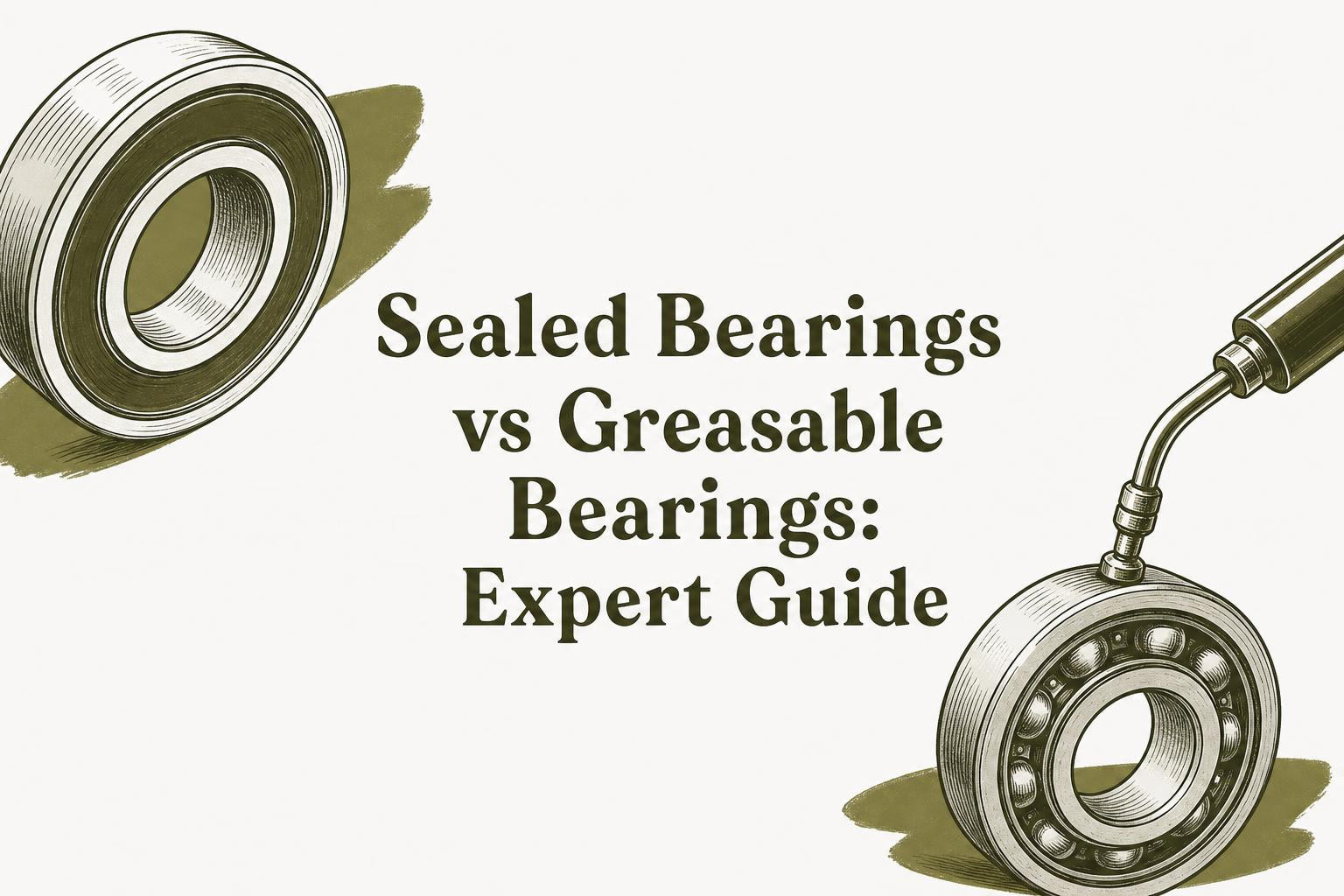
Sealed bearings come pre-greased from the factory and require no re-lubrication. Greasable bearings accept fresh grease through a zerk fitting at scheduled intervals. Sealed bearings win in most conveyor roller applications because contamination, not grease starvation, is the leading cause of bearing failure. In extremely dirty or wet environments, greasable setups let you flush contaminants out, but only if your maintenance team greases correctly every time.
This guide is written for maintenance teams, plant operators, and procurement staff choosing bearings for conveyor rollers and rotating equipment in mining, aggregate, cement, and bulk handling. By the end, you will know how sealed and greasable bearings differ, when each type fits your environment, and why the choice matters more than most people think for conveyor uptime.
If you are already shopping for steel side guide rollers built with contamination protection in mind, that link takes you directly to PROGUIDE’s product page.
What Is a Sealed Bearing?
A sealed bearing is a rolling-element bearing with built-in seals or shields that lock lubricant inside and keep contaminants out. These bearings are pre-greased at the factory (typically filled 25–35% with grease) and designed to operate for their full service life without re-lubrication. The industry sometimes calls them “lubricated for life.”
There are three main subtypes worth understanding:
Contact Seals (RS / 2RS)
A contact seal is a rubber component (usually Buna-N or nitrile) bonded to a steel insert. It presses continuously against the bearing’s inner ring, creating a physical barrier that makes it extremely difficult for dust, dirt, and moisture to reach the rolling elements. The designation “RS” means one side is sealed; “2RS” means both sides are sealed.
The trade-off: contact seals add a small amount of friction and heat, which slightly reduces maximum operating speed.
Non-Contact Seals (Labyrinth Seals)
Labyrinth seals create a tortuous path that contaminants must navigate to reach the bearing interior, but the seal itself never touches the inner ring. This means near-zero added friction. Labyrinth seals work well at higher speeds and in moderate contamination, though they offer less protection than contact seals in severely dirty or wet conditions.
Metal Shields (Z / ZZ)
Shielded bearings use thin metallic plates to block larger particles and retain grease. The shield does not contact the inner ring, so friction is minimal. “Z” means one shield; “ZZ” means both sides. Shields are less effective than rubber seals against fine dust or water ingress, making them better suited for cleaner environments.
What Is a Greasable Bearing?
A greasable bearing (also called a re-greasable bearing) includes a grease fitting that allows fresh lubricant to be pumped into the bearing at regular intervals. In conveyor roller applications, re-greasable bearings typically feature a drilled inner race or extended back closure that channels grease through a fitting on the end of the axle without requiring disassembly.
How Zerk Fittings Work
The standard grease fitting, called a zerk fitting (also known as a grease nipple or Alemite fitting), was patented by Oscar U. Zerk in 1929. It uses a ball check valve design: grease flows in under pressure from a grease gun, but the ball valve prevents contaminants from entering and grease from leaking back out. Simple, proven, and still the standard nearly a century later.
Sealed Bearings vs Greasable Bearings: Side-by-Side Comparison
When comparing sealed bearings vs greasable bearings, the right choice depends on your operating environment, maintenance discipline, and access to the bearing location.
| Factor | Sealed Bearings | Greasable Bearings |
|---|---|---|
| Maintenance required | None (lubricated for life) | Regular greasing on a PM schedule |
| Contamination protection | High (seal blocks ingress) | Variable (fresh grease can flush out contaminants, but dirty zerks introduce them) |
| Lubrication control | Factory-set, consistent | Operator-dependent, risk of over/under-greasing |
| Upfront cost | Slightly higher | Often cheaper per unit |
| Total cost of ownership | Usually lower (no labor, no grease) | Higher when you factor PM labor and grease cost |
| Failure risk | Seal degradation over time; cannot be rescued with fresh grease | Over-greasing blows seals; under-greasing starves bearings |
| Best environment | Moderate contamination, hard-to-reach locations, inconsistent PM teams | Severe contamination where flushing is beneficial, disciplined PM programs |
The Numbers Behind Bearing Failure
The statistics make a strong case for taking this decision seriously:
- Industry data attributes 14 to 25 percent of premature bearing failures directly to solid particle contamination.
- According to SKF’s failure analysis, about 15% of motor bearing failures trace directly to contamination, but since some contaminants degrade lubricant without leaving physical evidence, the real figure may reach 30%.
- A major refinery study found that 40% of rotating equipment failures came from bearing failure, and 48% of those bearing failures were caused by particle contamination.
- Up to 80% of bearing failures are tied to improper lubrication, whether that means too little, too much, the wrong type, or degraded grease.
Only about 34% of bearings ever reach their calculated fatigue life and “wear out” naturally. The rest die early from contamination, lubrication problems, or improper installation.
When Sealed Bearings Are the Better Choice
Sealed bearings win in most standard conveyor applications. Here is when they pull clearly ahead:
Hard-to-reach locations. Practitioners on forums consistently cite bad zerk access as a reason to go sealed. One user on The Combine Forum described a conveyor with “awful grease zerk locations” and was told by a bearing shop that sealed bearings are recommended “100% over greasable most of the time” because the quality is better. If your maintenance crew has to contort themselves to reach a fitting, they will eventually skip it.
Inconsistent maintenance programs. If your PM schedule is more of a suggestion than a rule, sealed bearings remove human error from the equation. One farmer on TractorByNet reported: “For a lot of things I’ve been replacing greasable with non-greasable bearings. I haven’t noticed any more failures with the non-greasable ones. Saves a lot of time.”
Moderate contamination environments. In facilities where dust exists but is not extreme (warehouses, clean manufacturing, covered transfer points), sealed bearings provide more than enough protection.
Liability and warranty concerns. Multiple practitioners note a practical benefit: “Manufacturer can’t say you didn’t grease it.” When a sealed bearing fails within warranty, the conversation is simpler.
Longevity in real service. One user reported that sealed bearings on a 1983 John Deere were still running after nearly 28 years of hard use. That kind of track record is difficult to argue with.
When replacing worn plastic guide rollers on conveyors, sealed bearings paired with a durable steel roller body represent a straightforward upgrade. For more on that comparison, see this guide on replacing plastic guide rollers with steel alternatives.
When Greasable Bearings Are the Better Choice
Greasable bearings earn their place in specific conditions, but only when maintenance is done right.
Extremely dusty or wet environments where flushing helps. The strongest argument for greasable bearings is the flushing effect. As one equipment operator put it: “Nice thing about greasable is the dirt and wrapped hay gets pushed out every time you grease.” The same principle applies to fine mineral dust in mining. Fresh grease displaces contaminated grease and pushes it out of the bearing.
High-heat applications. When ambient temperatures or friction loads degrade grease faster than a sealed bearing’s factory fill can handle, the ability to replenish lubricant extends bearing life.
Heavy-duty, slow-speed equipment with disciplined PM teams. Large, slow-turning bearings on heavy crushers or screens benefit from regular re-lubrication. The key word is “disciplined.” Without a real PM program, greasable bearings become a liability.
Extending a failing bearing’s life. One operator stated: “I like the idea when I know a bearing is starting to go bad, I can preserve its life a little longer by just keeping it greased.” In remote operations where replacements take days to arrive, this can be the difference between finishing a shift and shutting down.
A sealed bearing critic also raised a fair point about moisture: “They draw moisture when operating in damp weather. You can’t grease them to push the moisture out, so they get rust pits.” In constantly wet environments (outdoor stockpile conveyors, wash plants), this is a real consideration.
What About Conveyor Rollers?
This is where the sealed bearings vs greasable bearings debate gets specific and consequential. Conveyor systems in mining, aggregate, and cement operations face relentless contamination.
Dust Is the Number One Bearing Killer
In material handling, dust, dirt, and particles enter bearings and damage the rolling surfaces. Airborne contaminants are everywhere in these environments. Once inside the bearing, particles act like sandpaper, creating wear that eventually causes failure. Mining journal E&MJ has documented how conveyors operating in mines are “constantly exposed to large amounts of dust, water and grime, which can work their way into the bearing opening.” The resulting downtime and repair costs are a common pain across the industry.
The ISO 281 modified life equation uses a contamination factor (eC) that can reduce calculated bearing life by 50 to 90 percent in heavily contaminated environments. That is not a rounding error. It is the difference between a bearing lasting five years and a bearing lasting six months.
Sealed-for-Life Is Now the Standard
In modern conveyor roller design, sealed, lubricated-for-life ball bearings are the most common choice. Bearing selection depends on load, speed, contamination level, and required lifespan, but the industry has moved decisively toward sealed designs for idler rollers and guide rollers.
Side Guide Rollers Face Extra Risk
Side guide rollers sit near belt edges and transfer points, exactly where spillage and dust concentration are worst. Understanding where to position side guide rollers on a conveyor matters because placement directly affects how much contamination the bearing sees.
Belt mistracking compounds the problem. A misaligned belt pushes harder against guide rollers, generates more heat, and exposes bearings to greater side loads. Recognizing the signs of a misaligned conveyor belt early prevents cascading bearing failures.
The Hybrid Approach
Some roller designs combine sealed or contactless bearing sealing with an external mechanical dust cover that can be greased separately. This hybrid setup gives you the low-maintenance advantage of a sealed bearing while adding a greasable outer barrier that flushes contaminants away from the seal itself. The bearing stays clean, and the dust cover takes the punishment.
PROGUIDE’s steel side guide roller uses contactless sealing to reduce ingress of fines without added friction, with an optional mechanical dust cover that adds an external contamination barrier. This approach sits at the intersection of the sealed vs greasable debate: primary sealed protection, supplemented by an active external defense.
View the steel side guide roller specs and options →
Common Mistakes That Shorten Bearing Life (Either Type)
Whether you run sealed bearings or greasable bearings, these errors kill bearings early. Practitioners across forums and maintenance communities report the same mistakes again and again.
Over-Greasing
This is the single most common maintenance error with greasable bearings. As one experienced operator put it: “Most people over-grease them. Unless the manual specifically calls for it, greasing them until the grease runs out is a no-no, as the seals have just been popped.”
Blown seals from over-greasing turn a greasable bearing into an unprotected bearing. Regal Rexnord confirms that contact seals can be damaged by over-lubrication, causing increased operating temperatures and seal failure. In heavily contaminated environments, the accepted practice is to re-lube until grease exits the seal, but only if the shaft is rotating and grease is being added slowly with light line pressure.
One maintenance professional shared a telling example: a site was greasing motor bearings on schedule, and the bearings were failing within three years. After they stopped greasing entirely and switched to shielded (sealed) bearings, the bearings lasted five years. The greasing program was doing more harm than good.
Using Incompatible Grease
A field practitioner noted: “Most people are ignorant to the fact that not all grease is compatible with each other and screw up good bearings with the wrong grease.” Mixing lithium-based grease with polyurea grease, for example, can cause the mixture to soften and leak out of the bearing, leaving it unprotected.
Contaminating the Zerk Before Greasing
A nuanced view from TractorByNet captures this well: “Not cleaning dirty dusty grease zerks can put contaminants in the bearings.” If you push a grease gun onto a dirt-caked fitting, you are injecting abrasive particles directly into the bearing. Every grease cycle becomes a contamination event.
Ignoring the Environment When Choosing Bearing Type
A root cause analysis at one facility traced a bearing seal failure to using a standard contact seal in a highly abrasive, dusty environment where it was simply not effective. Matching the seal type to the contamination level is not optional.
For more on how environmental factors affect conveyor components, see this overview of common conveyor belt problems and solutions.
Under-Filling Sealed Bearings at the Factory
Some maintenance teams report a counterintuitive practice: prying off new sealed bearing seals before installation to add more grease, because “it is pathetic to see how little grease is in there.” The 25–35% fill is intentional (too much grease causes churning and heat), but the concern reflects a trust gap that some operators have with factory-sealed bearings.
Quick Reference: Bearing Seal Designation Codes
When ordering bearings, these suffix codes tell you what protection you are getting:
| Code | Meaning |
|---|---|
| RS | Rubber contact seal on one side |
| 2RS | Rubber contact seals on both sides |
| Z | Metal shield on one side |
| ZZ | Metal shields on both sides |
| LLU | Equivalent to 2RS (used by some manufacturers) |
| LLB | Non-contact rubber seal on both sides |
If you are replacing bearings in conveyor rollers, 2RS (double contact seal) is the most common specification for dusty environments. ZZ shields are acceptable in cleaner settings where speed matters more than contamination exclusion.
Understanding these codes helps when comparing types of guide rollers and their bearing specifications.
Seal Type Comparison
| Feature | Contact Seal (Lip Seal) | Non-Contact Seal (Labyrinth) | Metal Shield (ZZ) |
|---|---|---|---|
| Contamination exclusion | Excellent | Good | Moderate |
| Friction added | Higher | Very low | Low |
| Speed limit | Lower | Near bearing limiting speed | Near bearing limiting speed |
| Re-greasable? | Typically no | Sometimes | Not usually |
| Best environment | Dirty, wet, low-speed | High-speed, moderate contamination | Clean, moderate speeds |
Contact seals block contamination best but add friction and heat. Non-contact seals run with low friction and support higher speeds, but they protect less in dirty or wet conditions. Metal shields split the difference and suit moderate environments.
Choosing Between Sealed and Greasable for Your Conveyor
The decision comes down to three questions:
1. How contaminated is the environment? In mining, aggregate, and cement plants, dust is constant and aggressive. Sealed bearings with proper sealing (contact seals or labyrinth seals plus external dust covers) handle this better than greasable bearings in most cases. A scientific study examining 100 idler roller bearings on a belt conveyor found that the most dominant damage types were plastic deformation (42.3%) and corrosive wear (30.7%), both driven by contamination and moisture ingress.
2. How reliable is your maintenance program? If your team greases on schedule, uses the right grease, cleans zerks before greasing, and never over-greases, greasable bearings can work well. That is a lot of “ifs.” Improper lubrication sits at the root of 43% of mechanical failures. If there is any doubt about PM consistency, sealed bearings remove the risk.
3. Can you access the bearing for greasing? Side guide rollers on conveyors sit in tight locations near belt edges, return frames, and loading zones. If reaching a zerk fitting requires stopping the belt and removing guarding, the labor cost of each greasing event may exceed the cost of simply using a sealed bearing and replacing it at end of life.
Putting It All Together
The debate over sealed bearings vs greasable bearings is not abstract. It is a maintenance strategy decision with direct cost and uptime consequences.
For most conveyor roller applications, sealed bearings are the better default. They eliminate human error, reduce PM labor, and provide consistent contamination protection. Greasable bearings earn their place in extreme environments where the flushing benefit justifies the maintenance overhead, but only under disciplined programs.
The hybrid approach (sealed or contactless bearing sealing combined with a greasable external dust cover) gives you the best of both. The bearing stays protected while the external barrier actively repels contaminants.
If you’re selecting guide rollers for a conveyor in a dusty environment, PROGUIDE’s steel side guide roller uses contactless sealing with an optional mechanical dust cover. The matching guide roller bracket simplifies mounting.
Not sure which bearing protection setup suits your conveyor? Contact the PROGUIDE team for sizing and specification help.
Frequently Asked Questions
Do sealed bearings last longer than greasable bearings?
In most applications, yes. Sealed bearings eliminate the risks of over-greasing, under-greasing, and contamination through dirty zerk fittings. Only about 34% of bearings reach their natural fatigue life; the rest fail early from preventable causes. Sealed bearings remove several of those causes from the equation.
Can you add grease to a sealed bearing?
Not in the conventional sense. Sealed bearings are designed to operate with their factory grease fill for life. Some maintenance teams pry off seals to add grease before installation, but this risks damaging the seal and can cause over-filling, which generates excess heat.
Why do greasable bearings fail?
The most common cause is improper lubrication: too much grease (blowing out seals), too little grease (starving the rolling elements), incompatible grease types, or contamination introduced through dirty fittings. When lubrication is done correctly, greasable bearings perform well.
Are sealed bearings OK for mining conveyors?
Sealed bearings are the standard for modern conveyor idler and guide rollers. In mining and aggregate, pairing sealed bearings with external dust covers or labyrinth seals provides strong contamination protection without requiring a greasing schedule.
What does 2RS mean on a bearing?
The suffix 2RS indicates rubber contact seals on both sides of the bearing. This is the most common configuration for dusty or wet environments, providing the highest level of contamination exclusion among standard seal types.
How does a hybrid sealed-plus-greasable approach work on conveyor rollers?
The bearing itself is sealed or uses contactless (labyrinth) sealing, so it requires no re-lubrication. An external mechanical dust cover sits outside the bearing area and can be greased to flush away contaminants before they reach the seal. The bearing stays clean while the dust cover handles the harsh environment.